GESTE Foundation Supports Cooperative Self-Help in Uganda
On June 2, 2022, the Roman Catholic Bishop of Masaka, Serverus Jjumba, and Bernard Mutebi, employed as a cooperative officer at the local diocese, were guests at the GENO-Haus in Stuttgart. The guests from Uganda were received by Dr. Roman Glaser, President of BWGV and Chairman of the Board of the Cooperative Foundation for Development Cooperation (GESTE), Sebastian Gomolka, Managing Director of GESTE Foundation, and Steffen Müller, Deputy Head of the International Relations Department at the German Cooperative and Raiffeisen Confederation (DGRV), Berlin.
After a brief introduction of BWGV and the cooperative system in Baden-Württemberg by Glaser, Bishop Jjumba and Bernard Mutebi reported on the project supported by GESTE Foundation to establish a cooperative training center in Masaka, which Bishop Jjumba oversees as patron. Bishop Jjumba thanked for the support, and both visitors provided exciting insights into the current project status and achieved successes.
Ugandan project coordinator Bernard Mutebi had humorously illustrated the cultural differences between Uganda and Germany earlier this year in a presentation at the Parler-Gymnasium in Schwäbisch Gmünd: "In Germany, people wait for the bus, while in Uganda, the buses wait for the people, because the drivers have to wait until the bus is full." And when choosing between punctuality and serenity, people usually opt for serenity.
A Young Society in Search of Economic Opportunities
However, economic and social differences run much deeper. While population growth in Germany is about 0.2 percent per year, various statistics suggest that Uganda's population will grow by about 20 percent by 2027. Even today, Uganda is one of the countries with the youngest population worldwide. The average age is 15.8 years, and almost 50 percent are under 14 years old. Moreover, at the end of 2020, about 28 percent of Uganda's population had a per capita daily income of less than 1.90 US dollars. Creating employment perspectives for youth and young adults are crucial measures to promote economic development and education, increase the employment rate, and pave the way out of poverty.
The Sustainable Development Goals adopted by the global community in 2015, and Uganda's "National Development Plan III 2020/21 – 2024-25," highlight the importance of these fields of action.
Vocational Training as a Path to Economic Independence
At the end of 2019, the first GESTE project in Uganda started in cooperation with the Diocese of Masaka. The goal is to train around 30 young adults annually in craft skills, who in turn pass on their acquired knowledge to other young adults within their community. Organized as a cooperative, they receive not only craft skills but also knowledge about cooperatives to facilitate their entry into the working world. The latter is covered by a DGRV project funded by the Federal Ministry for Economic Cooperation and Development (BMZ). The craft skills are taught by trainers who are also active at a technical institute in the area.
Three Sustainability Goals in Focus
With the funding of the GESTE project in Masaka, the GESTE Foundation specifically promotes the following three goals from the Sustainable Development Goals:
- Goal 1: No Poverty – End poverty in all its forms everywhere;
- Goal 4: Quality Education – Ensure inclusive and equitable quality education and promote lifelong learning opportunities for all;
- Goal 8: Decent Work and Economic Growth – Promote sustained, inclusive, and sustainable economic growth, full and productive employment, and decent work for all.
The COVID-19 pandemic and the associated lockdown in the country initially caused delays. The project team saw this situation as an opportunity to respond, for example, by sewing masks and building mobile handwashing stations. Today, the results of the first project phase are visible. Around 300 young adults have acquired craft skills.
DGRV's office in Kampala supports the project on behalf of GESTE directly on-site with project management, accounting, and cooperative topics. Regular working meetings alternate between Kampala and Masaka to discuss current issues, challenges, and achievements.
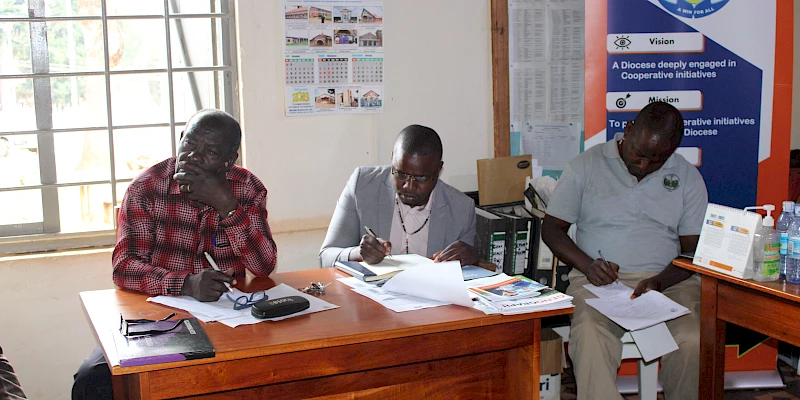
In mid-April 2022, project staff member Vastine Komwaka and project leader Martina Weis from DGRV in Uganda visited the project in Masaka to discuss content topics and, together with Bernard Mutebi, visit various workshops and small shops in the city where trainees already offer some of their products for sale. Products such as wood carvings, wooden bed frames, greeting cards, sandals, and clothing are examples from their range.
With the diocese as the initiator of the project, trainees benefit directly from work orders from the diocese itself. This facilitates the young people's smooth transition into working life—they gain experience and receive direct customer feedback with the support of trainers. In the past year, renovation work was carried out on the buildings, almost completely done by the trainees. Currently, trainees are working on an order to pave the driveway to various buildings on the diocese grounds. During the visit in April, a trainer demonstrated the pattern in which the self-pressed stones should be arranged.
The project enjoys high esteem in the diocese, and initial representatives from other dioceses have expressed interest in learning more about the project.